Helping a child who finds losing really hard
The goal isn't making losing enjoyable. It's helping your child practise experiencing disappointment, and choosing what to do next.
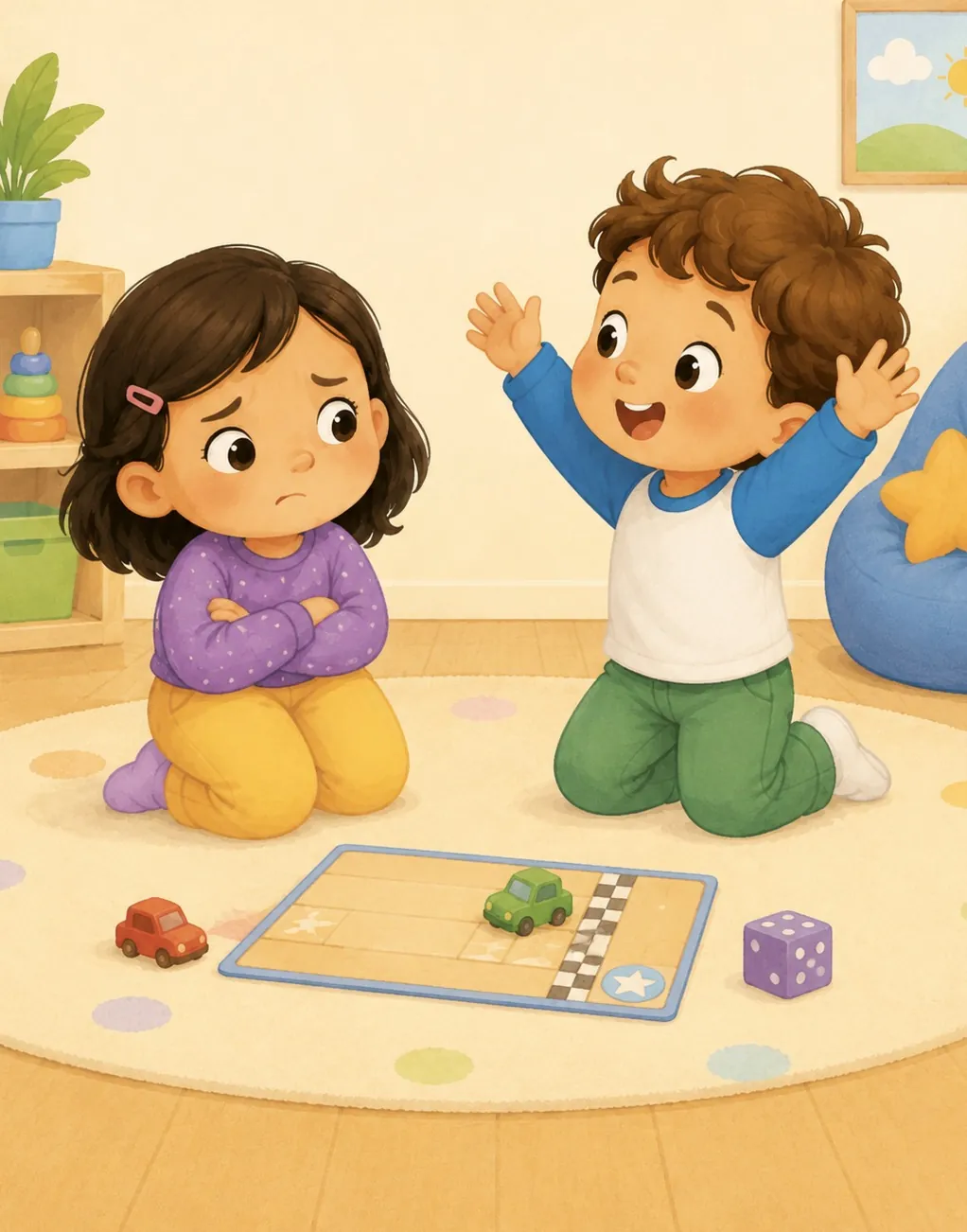
Big reactions to losing are common between 4 and 7, and they usually mean your child cares, not that they're being a poor sport. You're not trying to make them enjoy losing; you're helping them practise feeling disappointed and still deciding what happens next. That's a skill, and like any skill, it needs small, repeated, low-stakes chances to try it.
Why losing can feel so difficult
Wanting to win is completely normal. Losing creates an immediate, visible gap between what your child wanted and what actually happened, and at this age, that gap can feel enormous and permanent, even though it passes within minutes.
Many children this age also use winning as a rough measure of whether they're "good" at something. So a loss doesn't just feel like losing a game; it can feel, briefly, like evidence about themselves. That's worth remembering before assuming a strong reaction means poor sportsmanship: it usually means the opposite. They were genuinely invested.
What to do during the upset
Once the feeling has already landed, this isn't the moment for a lesson on gracious losing. It's the moment to help your child come back from the feeling.
- Stay calm yourself, and keep your voice low.
- Name what's happening rather than arguing them out of it: "You really wanted to win."
- Let the disappointment exist for a moment before you move to fixing anything.
- Keep any boundaries calm and clear, without shaming: "I won't let you throw the pieces."
Try saying: "It's OK to be disappointed."
What NOT to demand immediately
Do not insist on "Say well done!" while your child is still overwhelmed. Asking for graciousness before the feeling has settled usually teaches a child to perform calm rather than actually find it, and it can make the next loss feel even harder, because now there are two problems instead of one.
Genuine good sportsmanship can wait. It's something to model and practise later, when everyone is calm, not something to extract in the middle of the upset.
What to practise before playing
The best time to set expectations is before the game starts, not during it. A short, calm conversation beforehand does more than any reminder mid-game.
Before playing: ask, "What could we do if one of us feels really cross about losing?"
Agreeing on this together, including what you'll do if you lose, makes it a shared plan rather than a rule aimed only at your child.
Words parents can use
"You really wanted to win."
"It's OK to be disappointed."
"I won't let you throw the pieces."
"Do you want to take a break or stay and finish?"
A 5-minute Growing Wise scenario
When things are calm, ask: "You're one move from winning, and then you lose. What would you do?"
Let your child answer first, even if their idea is unusual. Then add one more idea of your own, so the conversation ends with options rather than a single "right" answer.
Games that give low-stakes practice
- Very short games. Quick rounds mean more chances to lose, recover and try again in a single sitting, rather than once a week.
- Cooperative games, occasionally. Games where you play as a team against the game itself take the sting out of losing, because nobody "beat" anybody.
- Adults modelling losing. Let your child see you lose sometimes, and say the recovery out loud: "Ah, I lost that one. Oh well, go again?"
- Celebrate effort or recovery, not forced enthusiasm. "You kept trying even after that round didn't go your way" matters more than requiring a smile.
When to take a break
If the upset is escalating rather than settling, more distressed, not less, after a minute or two, that's a good moment to pause the game rather than push on.
Offer the break as a genuine choice, not a punishment: "Do you want to take a break or stay and finish?" Either answer is fine. What matters is that coming back to play again later is always welcome, with no lecture attached.
Try the Growing Wise 5-minute activity
Games worth having on hand
Look for short, simple games with quick rounds and a bit of luck built in, so there are lots of small chances to lose and try again in a single sitting. If direct competition is still too much some days, working towards one shared result instead can offer a different kind of practice.

The Most Magnificent Thing (Ashley Spires)
- Best for
- Frustration, persistence, making mistakes and trying again
- Age
- 4-8
- Why we chose it
- A child has an idea, struggles again and again to make it work, gets very frustrated, steps away for a while, and comes back to it.
- Try asking
- "What do you think she could do when she feels like giving up?"
Want to practise this through stories or games?
We've collected some books and cooperative games that can make losing easier to talk about while everyone is calm. Books for children who find losing hard →
Cooperative games for children who hate losing →
Sources & further reading
- NSPCC: Anger management in children: how parents can help
- NHS: Dealing with child behaviour problems
Free pack: when losing ends in tears
Includes a “Losing a game” scenario card, the Pause–Think–Choose activity and 12 calm phrases for when a game goes wrong. Printable, for ages 4–7. Download it straight away.
Free. We’ll email you now and then with new activities. Unsubscribe anytime.
By the Growing Wise team · Last reviewed: 5 September 2026
Growing Wise offers educational ideas for parents and carers. It is not a substitute for professional medical, developmental or mental-health advice.