When a tiny change feels enormous
The sandwich is cut into triangles instead of squares, and suddenly the whole morning feels wrong.
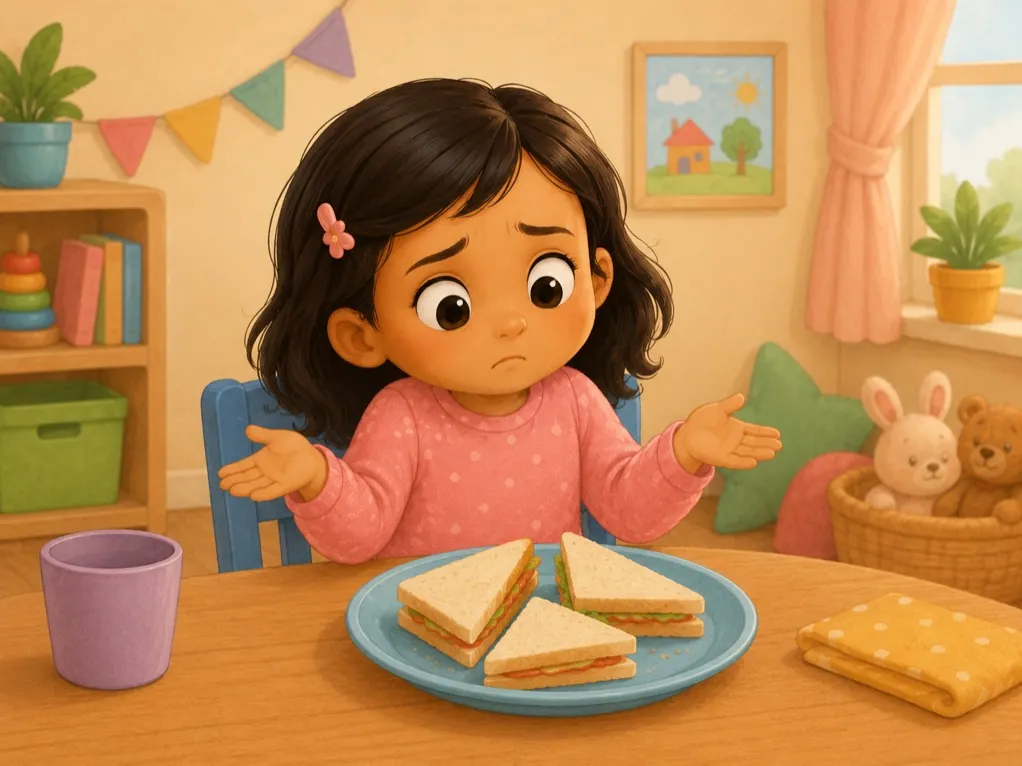
Small changes can feel enormous to children because they'd already pictured how things would go, and reality showed up differently. This isn't about the sandwich, and it isn't something to fix by teaching your child to stop having preferences. Preferences are fine. What helps is flexible thinking: having more than one possible response ready for when the plan doesn't match reality. In the moment, name what changed before you try to solve it. Afterwards, build that flexibility gently, while everyone is calm.
Why small changes can feel difficult
Young children plan more than we often notice. Squares, not triangles. The blue cup, not the red one. This route to nursery, not that one. When reality doesn't match that picture, the mismatch itself is the problem, not the sandwich, the cup or the route.
At this age, most children only have one plan loaded at a time. When it doesn't work, there isn't automatically a second one sitting ready to take its place, so the reaction can look much bigger than the actual change.
It's worth being clear about what the goal is, and what it isn't. The aim is not to teach your child that the shape of a sandwich shouldn't matter to them, or that they should stop minding when things don't go as expected. Having preferences is normal. The aim is to help them build a second, third or fourth option, so that when plan A doesn't happen, there's already something else to reach for.
What to do in the moment
When the reaction is already happening, the most useful first move is to name the mismatch clearly, rather than argue about whether it matters.
- Name what changed, plainly: "You wanted squares and these are triangles."
- Acknowledge it before you try to fix anything: "That wasn't what you expected."
- Reassure them what's actually still true: "The sandwich is still safe to eat."
- Then open the door to a next step, without supplying it yourself straight away: "What could we do now?"
Try saying: "You wanted squares and these are triangles. That wasn't what you expected. The sandwich is still safe to eat. What could we do now?"
How to prepare for predictable changes
Some changes can be seen coming: a different routine on a school inset day, a visit to a new place, a swap in who does the school run. For these, a little advance notice does a lot of the work before the moment even arrives.
- Give advance warning where you can: "Tomorrow looks a bit different: Grandma's picking you up instead of me."
- Use pictures or a simple visual timetable for transitions that happen often, so the sequence itself becomes familiar even when a detail changes.
- A visual timer can help make "in a few minutes, we're changing activity" feel concrete rather than sudden.
None of this guarantees a smooth reaction, but it moves the change from "sudden and unexplained" to "already partly expected", which is usually easier for a young child to absorb.
How to practise flexibility while calm
Flexible thinking is a skill, and like any skill it's easier to build outside the moment it's actually needed. Once everyone is relaxed, a few small, low-stakes habits can help.
- Occasionally make tiny, harmless changes on purpose: a different colour cup, a new route to the park, dinner in a slightly different order. Keep these genuinely small and low-stakes, framed as an ordinary part of life rather than a test.
- After any change, real or practised, offer two acceptable choices rather than one instruction: "We could use a bowl instead, or cut these into squares. Which sounds better?"
- Talk briefly, afterwards, about what happened: what changed, how it felt, and what else could have worked. Keep it short: a quick chat, not a re-run of the upset.
One important line: this is never about deliberately upsetting or distressing a child in order to "give them practice." The changes you introduce on purpose should stay small enough that they're barely noticeable as a challenge at all; the practice comes from repetition, not from intensity.
Words parents can use
Naming it: "You wanted X, and you got Y instead. That wasn't what you expected."
Reassuring: "It's different, but it's still okay; you're still safe, and this still works."
Opening it up: "What could we do now?"
Offering a choice: "We could try it this way, or that way. Which one do you want?"
5-minute sandwich scenario
When things are calm, describe the scenario: "Imagine you wanted your sandwich cut into squares, but it came out as triangles. You weren't expecting that."
Ask: "What could you do?" Let your child answer first, even if the idea is simple ("eat it anyway" counts). Then add one more possibility of your own, so they finish with at least two ways through, not just one.
When additional support may be useful
Most children find at least some changes hard, and flexible thinking tends to develop gradually, with a lot of ordinary repetition along the way rather than all at once. It's also common to see this get temporarily harder around bigger transitions, like starting a new school year or a change in family routine.
If unexpected changes consistently cause distress that's intense, lasts a long time, or shows up the same way across very different settings and people, it's worth mentioning to your GP, health visitor or school. They can help you understand what additional support, if any, might help.
Try the Growing Wise 5-minute activity
Practising "what could we do?" in a low-pressure picture scenario is a good way to build this skill without the emotional stakes of a real moment.
Try the Growing Wise 5-minute activity
For more on predictable routines, advance warning and visual supports, see when your child needs to know what happens next.
A story about handling change

The Koala Who Could (Rachel Bright & Jim Field)
A natural conversation starter for children who find change or unfamiliar situations difficult, told through a bendy koala learning to loosen up. It suits younger children (from about age 3) who respond well to a playful, rhyming story rather than a direct conversation. Good to read before a change you already know is coming, such as a new routine or a house move.
Sources & further reading
- Department for Education: Sense of self (personal, social and emotional development)
- Sheffield Children's NHS Foundation Trust: Change and transitions: top tips
Free activity pack for ages 4–8
Printable scenario cards and three 5-minute activities for practising moments like this together. Download it straight away.
Free. We’ll email you now and then with new activities. Unsubscribe anytime.
By the Growing Wise team · Last reviewed: 5 September 2026
Growing Wise offers educational ideas for parents and carers. It is not a substitute for professional medical, developmental or mental-health advice.